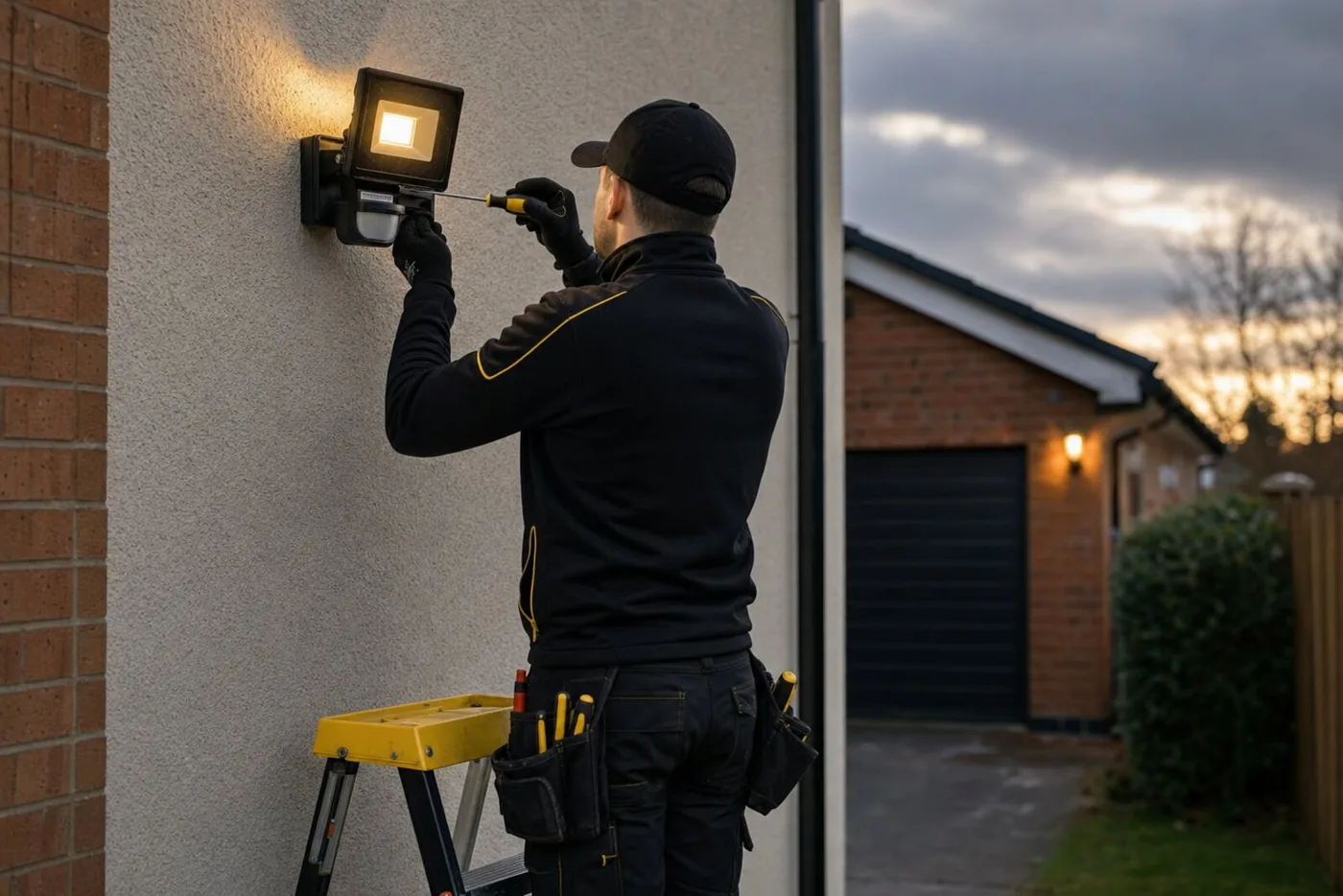
Outdoor security lights are one of those jobs people often treat as simple: buy a floodlight online, fix it to the wall and plug it in. The trouble is that outdoor electrics have less margin for error than people think.
A light that trips in rain, flickers or stays on all night needs its symptoms separated: a sensor setting is a different problem from moisture in a fitting or damaged cable. Start with what the light is doing, when it happens and whether the circuit trips.
What the 2026 floodlight safety report found
The GOV.UK product safety report said the floodlight's supplied cord was not suitable for outdoor use and would deteriorate in the sun. It also said the supplied plug did not meet BS 1363 dimensional requirements, meaning it could not make a secure connection with the socket.
That is a useful reminder that an outdoor light is not safe simply because the listing says "outdoor". In practice, the weak point is often the cable, plug, connector or general build quality rather than the LED lamp itself.
Outdoor cable and fittings matter more than people expect
Electrical Safety First says only extension leads, cables and connectors suitable for outdoor use should be used outside, and they need to be weather-resistant and kept free from damage. The same common-sense rule applies to floodlights, switched spurs and any accessories feeding them.
A fitting exposed to sun, rain and temperature changes needs the right cable route, proper terminations and suitable weather protection. If a flex looks thin, generic or not really intended to live outdoors year-round, it is not something to ignore.
The DIY trap with security lights
Security lighting often gets bundled into wider weekend jobs such as garden tidy-ups, repainting, fixing fences or adding cameras. That is where people start drilling near hidden cables, reusing whatever junction box is lying around or extending an old supply because it looks close enough.
Electrical Safety First's DIY guidance is blunt on this point: if you are not sure, do not DIY, and new-circuit work or higher-risk work in the home falls under Part P rules. Even where the job looks small, a poor connection or unsuitable accessory outside can leave you with nuisance tripping, water ingress or heat damage later.
What to look for around a Doncaster home
Typical weak spots are side passages, back doors, garages and older rear extensions where lighting has been added in stages over the years. A floodlight may still work while the cable sheath is cracking, the fitting has filled with water, or the supply point inside has been left untidy behind a spur or accessory.
If a light flickers, trips an RCD in wet weather, shows condensation inside the fitting, runs unusually hot or has visible UV damage to the cable, stop treating it as cosmetic. Those are the sort of faults that usually get worse rather than better.
When it is better to get it checked properly
If you want a new floodlight in a better position, a PIR added, an unreliable outside light repaired or the existing supply checked for RCD protection, it is usually quicker to sort it properly than keep nursing a marginal setup through another year.
For some Doncaster households the answer is just replacing a poor fitting with a decent one. For others, especially where the wiring has been altered bit by bit, it is worth checking the fixed wiring and protection at the same time so the new light is not being added onto an existing weak point.
Security light installation and fault repairs in Doncaster
Why does a PIR security light stay on?
Check the user instructions for the time, daylight and sensitivity settings, and whether manual override has been enabled. Passing traffic or movement near the sensor can trigger repeated operation. Only adjust user controls you can reach safely; leave wiring and sealed parts alone.
When planning a replacement, explain which path, gate or doorway needs lighting. A more powerful floodlight may create glare without improving that area. Aiming and sensor position should keep light away from neighbouring windows and public roads while covering the approach you actually use.
Quick outdoor security light checks
- Be wary of cheap online floodlights with vague branding or poor product information.
- Check that any outdoor cable, connectors and accessories are actually suitable for external use.
- Do not ignore flickering, condensation, cracked cable sheathing or wet-weather tripping.
- Make sure outdoor equipment is RCD protected.
- If the setup has been pieced together over time, consider having the supply and fitting checked properly.